Concentrating Solar Power
Solar Thermal
Solar thermal devices use direct heat from the sun, concentrating it in some manner to produce heat at useful temperatures. The modern solar industry began with the oil embargo of 1973-1974 and was strengthened with the second embargo in 1979. The growth of the solar industry during this period of fuel shortages and high prices (1974-1984) soared from 45 solar collector manufacturing firms to 225 firms.The solar market was helped during this period by government assistance, both Federal and State. Currently, solar thermal devices do everything from heating swimming pools to creating steam for electricity generation.
Concentrating Solar Power
Concentrating solar power (CSP) technologies use mirrors to reflect and concentrate sunlight onto receivers that collect the solar energy and convert it to heat. This thermal energy can then be used to produce electricity via a steam turbine or heat engine driving a generator.
The U.S. Department of Energy (DOE) is ramping up its CSP research, development, and deployment efforts, leveraging both industry partners and the national laboratories. DOE's goals include increasing the use of CSP in the United States, making CSP competitive in the intermediate power market by 2015, and developing advanced technologies that will reduce systems and storage costs, enabling CSP to be competitive in the baseload power market by 2020.
DOE plans to achieve these goals through cost-shared contracts with industry, advanced research at its national laboratories, and collaboration with other government agencies to remove barriers to deploying the technology.
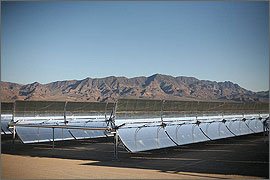 Within the CSP subprogram, research and development activities focus on the following areas:
- Linear Concentrator Systems
- Dish/Engine Systems
- Power Tower Systems
- Thermal Storage
- Advanced Components and Systems
You can also learn more about the basics of CSP operations within the main technology areas.
Concentrating solar power technologies can generate electricity at relatively low cost and deliver power during periods of peak demand. In addition, integration with low-cost thermal storage adds significant value to the energy delivered from CSP plants. The public is becoming more familiar with the availability, benefits, and economic feasibility of CSP. And researchers are continuing to discover ways to reduce costs and improve efficiencies. Consequently, many utilities are including concentrating solar power in their power-generation portfolio, helping our nation reduce its dependence on fossil fuels.
CSP is one of four subprograms within the Solar Energy Technologies Program (SETP), along with Photovoltaics, Market Transformation, and Systems Integration. The SETP subprograms focus on accelerating the advancement of solar energy technologies to make solar electricity more cost competitive with conventional forms of electricity.
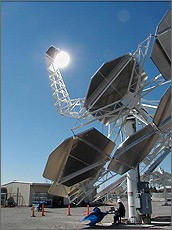 Concentrating Solar Power Basics
Concentrating solar power (CSP) offers a utility-scale, firm, dis-patchable renewable energy option that can help meet our nation's demand for electricity. CSP plants produce power by first using mirrors to focus sunlight to heat a working fluid. Ultimately, this high-temperature fluid is used to spin a turbine or power an engine that drives a generator. And the final product is electricity.
Concentrating solar power systems can be classified by how they collect solar energy.
Smaller CSP systems can be located directly where the power is needed. Single dish/engine systems can produce 3 to 25 kilowatts of power and are well suited for such distributed applications. Larger, utility-scale CSP applications provide hundreds of megawatts of electricity for the power grid. Both linear concentrator and power tower systems can be easily integrated with thermal storage, helping to generate electricity during cloudy periods or at night. Alternatively, these systems can be combined with natural gas, and the resulting hybrid power plants can provide high-value, dis-patchable power throughout the day.
These attributes—along with world-record solar-to-electric conversion efficiencies—make CSP an attractive renewable energy option in the southwestern United States and other sunbelts worldwide.