Solar Lighting Basics
Research under way at Oak Ridge National Laboratory (ORNL) could lead to entirely new, highly energy-efficient ways of lighting buildings using the power of sunlight. This new technology, called Hybrid Solar Lighting, (HSL) would use sunlight to simultaneously light interior spaces and generate electricity.
Hybrid solar lighting makes better use of sunlight in its natural form and specifically targets the energy consumed by electric lights—the largest consumer of electricity in commercial buildings. Electric lighting accounts for more than a third of all electricity consumed for commercial use in the United States.
HSL, currently in the research and development phase, would use a specially designed collector to focus natural, full-spectrum sunlight into optical cables while simultaneously converting otherwise wasted infrared energy into electricity. The optical cables would then deliver the full-spectrum sunlight to light fixtures throughout a building. Additionally, HSL would convert sunlight to electricity much more efficiently than conventional solar technologies.
In a solar lighting and power system, the roof-mounted concentrators collect sunlight and distribute it through the optical fibers (enlargement) to hybrid lighting fixtures in the building's interior. The system also produces electricity for supplemental lighting or other uses
Solar Lighting in Use
There are currently two proposed applications for hybrid solar lighting systems. First, hybrid lighting systems are being developed for use in commercial buildings to displace electric lighting, which consumes a large portion of electricity in commercial buildings. The figure below illustrates one system configuration being developed for this application.
Second, researchers are investigating the use of HSL as a key component in new hybrid solar photobioreactors that sequester carbon via enhanced photosynthetic-based bio-processing at power plants, illustrated below.
Solar Lighting Research and Development
| The sky simulator provides a test facility for researchers and building design professionals to conduct model studies on daylighting. The facility is operated collaboratively by LBNL and the University of California Berkeley, Center for Environmental Design Research. |
HSL does not waste any portion of the sunlight. It delivers the visible portion of sunlight deep into the building to provide interior lighting, and it uses the remaining "invisible" portion of the sunlight to generate electricity.
Rather than solely converting sunlight into electricity, HSL collectors concentrate sunlight into flexible optical fibers. Sunlight is routed into buildings using the flexible cables. The sunlight is then combined with electric light in specially designed "hybrid" light fixtures.
The natural and electric light sources work in unison to illuminate the inside of buildings. Lighting controls automatically reduce the amount of electric light used in accordance with the amount of sunlight that is available. In addition to being more efficient than commercially available solar options, hybrid solar lighting brings highly preferred, full-spectrum sunlight inside buildings. Full-spectrum sunlight is preferred over incandescent or fluorescent light because it can help realize performance and health benefits for people of all ages
The remaining "invisible" energy in the sunlight, mostly infrared radiation, is directed to a concentrating thermo-photovoltaic cell that very efficiently converts infrared radiation into electricity. The resulting electric power can be directed to other uses in the building.
Independent cost and performance models suggest the overall affordability of solar energy could be doubled or tripled using this new hybrid approach. The multidisciplinary R&D effort includes several industrial and university partners.
Compared to earlier light collection systems for solar lighting applications in buildings and photobioreactors, the proposed hybrid collector design provides several advantages:
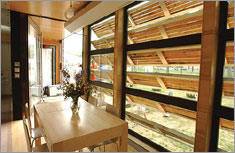 |
| The University of Virginia's Solar Decathlon House shows excellent use of direct solar lighting. |
- Fewer, easily assembled, system components integrated into a smaller, less costly, and more compact design configuration
- Improved IR heat removal and management
- Improved optical fiber placement and articulation (bundled and pivoted about a radial axis)
- A longer optical path for light and lower entrance angles for visible light entering large-core optical fibers. This results in much lower overall transmission losses in the accompanying light delivery system
- Centrally-concentrated IR radiation, allowing for convenient implementation of IR-TPVs.
Solar Lighting For Consumers
Hybrid Solar Lighting promises numerous benefits to consumers. Initially targeting large commercial audiences, the HSL technology could eventually be viable for home use. The HSL technology will drastically reduce system cost and the cost per lumen generated as the table below illustrates. The economic benefits will be extended as worker productivity increases and health improves from working in and environment that has sufficient full spectrum sunlight.
The table compares the projected cost and performance of the proposed system with that of a state-of-the-art commercial system. The anticipated cost per delivered lumen of the proposed system far is much less than that of its only commercial counterpart.
| Cost and performance comparison between hybrid solar concentrator and commercial system applied to both applications. | ||
| Parameter | Proposed System | Commercial System |
| System Cost | $2000/m2 | $5000/m2 |
| Delivered lumens (buildings) | 50,000/m2 | 25,000/m2 |
| Delivered lumens (photobioreactors) | 60,000/m2 | 25,000/m2 |
| $/delivered lumen (buildings) | $0.04/lm | $0.20/lm |
| $/delivered lumen (photobioreactor) | $0.03/lm | $0.20/lm |
U.S. Department of Energy - Energy Efficiency and Renewable Energy